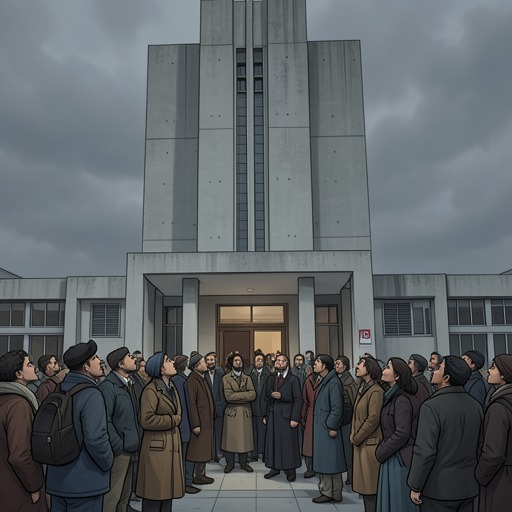
Hans Meyer's Chess Set
The Collini CaseHans Meyer’s Chess Set connects Caspar Leinen’s childhood bond with Hans Meyer to the courtroom where Leinen later defends Fabrizio Collini, the man accused of killing him. First used in their games at Meyer’s office, it reappears years later amid the murder files and finally as a single chess piece placed before Leinen at trial. The set does not explain the case; its significance lies in the way an intimate object persists as Leinen tries to make sense of the killing and his own divided loyalties.
The Set in Meyer’s Office
During Philipp’s extra coaching, Leinen spent alternate afternoons with Philipp’s grandfather, Hans Meyer. Sometimes the two played chess on a very old board. Meyer was patient with the boy, occasionally let him win, and gave him money when he did. The games belong to the ordinary pattern of their companionship: time together arranged around Philipp’s lessons, with Meyer acting as an indulgent older presence in Leinen’s life.
The board is described as old, but the narrative gives no account of its design, maker, or full history. Its meaning comes instead from its use and from the relationship formed around it. Chess brings the two together repeatedly, and the pieces are part of a personal setting in which Meyer can show patience and affection without making either explicit. The set’s later importance grows out of this earlier familiarity, rather than out of any special value assigned to it at the time.
A Parting Object
During a later visit, Meyer turned away to the window, opened both panes, and stood leaning against the frame. Leinen got up and went to him; Meyer turned and hugged the boy, then said he wanted to be alone. The following morning, as Leinen drove home, he found the old chess set on the passenger seat of his car. The sequence makes the set a quiet, material remainder of their parting: no explanation accompanies it, and the account does not explicitly describe it as a formal gift.
That unspoken quality distinguishes the object’s transfer from the games that came before. At the office, the board had been something they used together; on the passenger seat, it has been left for Leinen to find after an emotionally charged farewell. The gesture gives the set a personal history that can travel beyond Meyer’s house. Later, when Leinen’s work becomes inseparable from the case surrounding Meyer’s death, this remembered connection is present in tangible form, without resolving the conflict that the case creates.
Among the Murder Files
Years later, on the night before the trial begins, Leinen stays in his chambers until half past three in the morning. He has divided the papers across his desk into witness statements, expert opinions, police reports, and forensic evidence, still searching for a small detail that might explain the murder. Beside the desk stands Meyer’s chessboard. Its old chessmen have been separated and placed between the stacks of paper, serving as paperweights.
The arrangement puts the set into a new, practical role. The pieces that once moved across a board in a game now hold down the documents Leinen is trying to order into an account of the killing. The scene makes his investigation concrete: the papers are physically sorted, yet he remains unsure what he is looking for and hopes for a key that will put the world back in order. The chess pieces do not supply that key. Instead, their presence links his search through the evidence to the earlier relationship with Meyer, a connection he cannot set aside simply by arranging the case files.
The same late-night scene places the object among other reminders of Leinen’s personal ties. Four black-and-white photo-booth pictures of Johanna Meyer are taped to his lamp, and he thinks of her because she will be in court the next day to see her grandfather’s killer. The board and photographs occupy different places in the room, but together they frame the case as both legal work and a confrontation with people and memories from Leinen’s life. As the night continues, he takes only the arraignment document in his briefcase, leaving the chessboard behind but carrying one piece with him.
The White King in Court
Before leaving his office, Leinen puts the white king from Meyer’s set into his trouser pocket. He walks through Berlin in the cold, thinking about the trial and the rules that govern it: three professional judges, two lay judges, the prosecutor, the accessory prosecutor, and himself will sit in judgment of a man. The procedural rules are numerous and strict, and a failure to observe even one can overturn a verdict. In this setting, the king is a private object carried alongside the formal documents of the case, not a piece of evidence presented to the court.
When Leinen takes his place in court the next morning, he removes the charge document from his briefcase and places the white king on the table in front of him. Johanna is the last to arrive, avoiding the need to speak with the press; Leinen can hardly bear to see her on the opposite side in the case. The object is thus visible at the point where his professional role and personal history meet. It recalls Meyer without displacing the legal proceedings, and its quiet presence contrasts with the cameras, files, and public attention surrounding Collini.
Recurrence and Significance
Across these appearances, the set changes function while retaining its association with Meyer and Leinen. It begins as the means for repeated games between a boy and an older man; after their parting, it appears in Leinen’s car; during the murder investigation, its pieces hold down the very files through which Leinen searches for an explanation; at the trial, the white king is placed on the defense table. The movement from shared play to solitary investigation and then public courtroom is carried by a physical object rather than by an explanation of what Meyer meant to Leinen.
The white king concentrates that history into a single piece. Leinen does not take the whole set into court, but selects one figure and puts it before him as the hearing begins. The narrative does not state what he intends the gesture to mean. Its placement nonetheless makes the connection legible: the accused man’s case concerns the death of someone who had once shared chess with Leinen, and the defense lawyer brings a remnant of that relationship into the room where he must act in his professional capacity. The set therefore functions as a recurring link between private memory and public justice, while leaving the moral and legal questions of the trial unresolved.